When Polestar, Volvo’s standalone, performance electric vehicle brand, launched its first vehicle last year, it came in limited flavor. It was only available in a dual-motor, all-wheel-drive configuration and cost around $50,000 before incentives. For 2022, Polestar is rolling out a more affordable, single motor, two-wheel drive version of the sedan, that offers many of the features of the dual-motor Polestar 2 with a few changes that make it a bit more affordable, appealing, and a bit greener for those looking to make the electric switch.
Single or dual motor
With an estimated range of 270 miles, a bit less oomph, fewer packages but plenty of technology to make your drive easier, the 2022 Polestar 2 Single motor offers a Polestar-estimated 270 miles of range. Rather than having two motors that power all four wheels, like it does in the Dual motor version, this Single motor version, which puts out 231 horsepower and 243 lb-ft of torque, pushes all its power to the front wheels.
Polestar, unlike many other electric carmakers, is transparent about the Polestar 2 Single motor’s useable battery capacity. The 78 kWh battery pack sits under the floor, between the front and rear wheels, and Polestar says that it’s usable capacity is 75kWh. That’s the same battery pack that is in the Polestar 2 Dual motor, but Polestar can and has pushed over-the-air updates to all Polestars to help make charging faster and tweak battery settings to make them more efficient.
The 2022 Polestar 2 Single motor sedans also get the optional addition of a mechanical heat pump (available in the Plus Pack for $4000 more) that helps maintain that charge in more adverse climates. Polestar stays that under certain climate conditions the heat pump will scavenge heat from the outside air to extend the range of the vehicle by as much as 10%. Using Polestar’s estimate, that means that the 2022 Polestar 2 Single motor could gain an additional 27 miles of range thanks to the heat pump.
For this model year, the fully loaded Launch Edition has been eliminated. The Polestar 2 Single motor replaces it and comes with a simplified, and less loaded set-up including a metal roof instead of the Launch Edition’s glass one, environmentally-friendly upholstery and a choice of a handful of option “packs,” as Polestar calls them.
You can opt for the Plus Pack, which includes the heat pump, a glass panoramic roof, Harmon Kardon premium audio, and a wireless phone charger (amongst other things). This pack was on the prototype Polestar 2 I drove. You can also opt for the the Pilot Pack ($3,200 more) which includes things like adaptive cruise control and LED exterior lighting. Sadly, the vehicle I drove did not have the upgraded ADAS system so I was not able to test out what Polestar says offers Level 2 driver support aids on my drive.
Native Android OS and OTA updates
Polestar has the accolades of being the first vehicle to be built with Google’s Android OS at its heart. While parent/partner company, Volvo has also rolled out the platform in some of its vehicles like the Volvo XC40 Recharge, the entire Polestar brand uses the platform.
Android OS is not the same as Android Auto. It’s an operating system that Google opened to manufacturers a few years ago, with the goal of getting them to integrate the system into their vehicles.
Android Auto is a program that overlays on your phone, while Android Automotive OS is an open-source operating system that runs on Linux and can be used in vehicles. Google has been working with a number of automotive companies to embed the system into new cars so that apps like Google Maps, Google Assistant and the Google Play Store can run seamlessly in vehicles, and the system just keeps getting better.
You can choose to access almost everything in the 2022 Polestar 2 Single motor via voice control, by using the convenient “Hey Google,” initiation phrase. This phrase gets you access to evertyihng frim climate control to driving directions and since we’ve all been so deeply steeped in the Google infrastructure for so long now, it’s all highly intuitive. Tell the system you’re feet are hot and Google OS will lower the temperature in the footwell. Want to find the best taco place in Santa Barbara? Just ask Google to search then navigate there like I did. I rarely touched the touchscreen while driving, as I could pretty much do everything I needed, just by asking Google to do it for me.
Natural language recognition is something Google has been working on diligently for many years and it keeps getting better. A few times, when using the system, I botched a request or awkwardly asked for something like adding a stop at a local beach to take photos. The system didn’t miss a beat and untangled my language to do just what I asked it to do.
In the Polestar 2 Single motor I drove, charging locations were somewhat integrated to the Google Maps platform on Android OS–with some caveats. Ask Google to find charging stations along your route, and you can filter by brand. While doing so in Google Maps won’t tell you if a charger is available or working, Polestar has partnered with ChargePoint to provide charging access, and you can use the ChargePoint App, installed on the center screen, to learn more about your selected charger. It does take some tapping around the screen before hitting the road, which means you’ll still need to pull over, and stop before heading to the nearest charger, but on my 200 mile trip from the Pacific Design Center in Hollywood to Santa Barbara I didn’t need to stop to recharge.
If I had needed to recharge, Polestar says that on DC Fast chargers I could have expected to get to 80% charge in just about 30 minutes. That’s down from the 40 minutes it used to take to get to an 80% charge, according to Technical Operations Specialist, Glenn Parker. Parker also said that continued over-the-air updates will improve the efficiency and range of the entire Polestar line up as the company rolls out updates to all owners.
While finding an available charger is still clunky, the integration of Google Maps into the very technological fabric of the Polestar 2 means that your estimated range is displayed each time you navigate to a new place or add a stop along the way. On my day trip, I arrived at each destination with a few miles more range than the system originally thought I’d have, which was a nice surprise given that I timed my return to LA badly and sat in Westside traffic for 45 minutes, while the range hovered down around 20%.
On the road
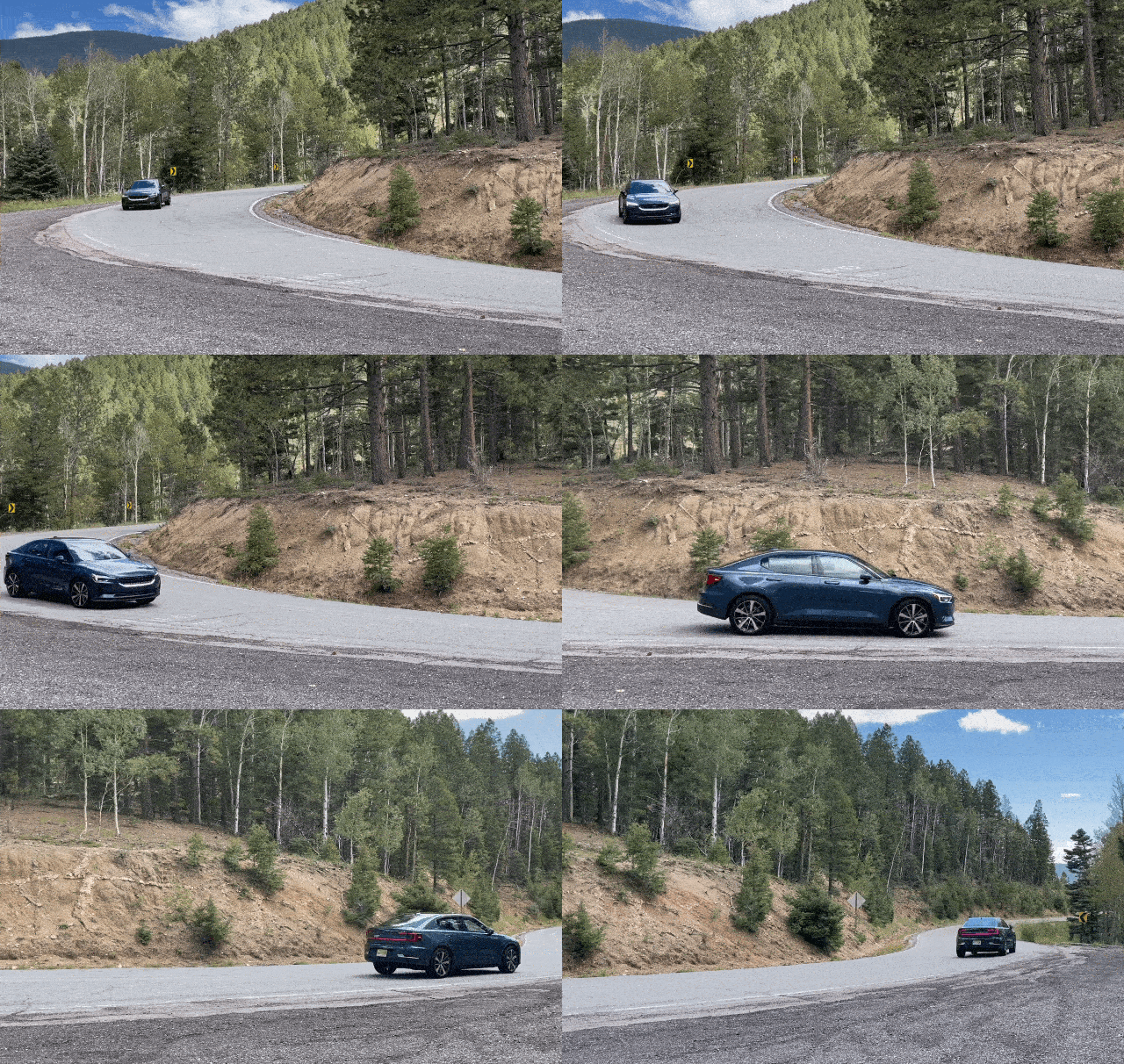
Video by Kirsten Korosec (separate drive)
The Polestar 2 Single motor is quiet, comfortable and quick. Polestar says that it does 0 to 60 in 7 seconds, and while that doesn’t seem like much, it’s plenty to get you merged into traffic on the highway, especially because the low-end torque is so readily available. On the prototype I drove, you could adjust a few driving features including steering feel and one-pedal braking, and you could toggle some of the driver assistance systems like lane departure warning on and off. Unfortunately, my test vehicle did not have any of the advanced driver aids that Polestar offers in the Pilot pack so I didn’t get to test those.
One of the joys of electric vehicles is the availability of braking mode, B Mode, or one-pedal driving. Essentially you’re adjusting the level of regeneration you get from the rolling wheels when you lift off the accelerator.
You can roll to a stop or, in the Polestar 2 “creep,” a setting you can toggle on and off through the infotainment screen, without ever touching the brake. I drive most electric vehicles with the most aggressive braking setting, as its the most efficient and most enjoyable mode to employ in Los Angeles traffic. While most people may find the highest setting in the Polestar 2 to be a bit surprising, after a few minutes of getting used to it, it becomes intuitive to use. I did however turn off the “creep,” function as it felt unnatural when paired with the regenerative braking mode.
I also spent 90% of my time behind the wheel using the most aggressive steering setting, called “Firm.” Essentially the system changes the steering ratio based on the setting you’ve chosen. Firm offers the most direct feeling response, while the softer settings make the Polestar feel a bit more roly-poly and slow to respond.
Right-to-repair, recondition, recycle
Polestar makes no bones about its commitment to greener manufacturing and materials. To that end, the company is proactively considering the entire lifecycle of the batteries in its vehicles. According to Parker, the company uses blockchain to track the mining of Cobalt for it’s batteries and is looking into using the system to track other elements used in building their vehicles.
In addition to this, Polestar has also thought relatively comprehensively about the battery and owner lifecycle. The stacked packs in the Polestar 2 Single motor can be individually replaced as parts fail. Parker said that if one component fails, the company collects that material back to form a closed loop system. “We’re exploring remanufacturing and reusing those components that come back,” he said. Polestar also offers complete repair instruction and access to a catalog of parts that owners can purchase directly from the company itself, too.
Prices for the Polestar 2 Single motor start at $45,900 and vehicles will be available starting January 2022. If your state offers incentives for owning an electric vehicle, Polestar says that price can come down around $35,000.
source https://techcrunch.com/2021/11/24/the-newest-polestar-2-is-more-appealing-affordable-and-repairable/
No comments:
Post a Comment